Buying a Business With an SBA Loan? What Your Lender Now Wants to See
01
Your lender now wants more cushion before it says yes.
1.15 → 1.25 · SBA SOP 50 10 8.1, Appendix 15, effective Oct 1, 2026. Read the detail
02
A forecast alone no longer carries your deal.
Projections → Past statements · The old rulebook asked for projections; the new test starts from statements. Read the detail
03
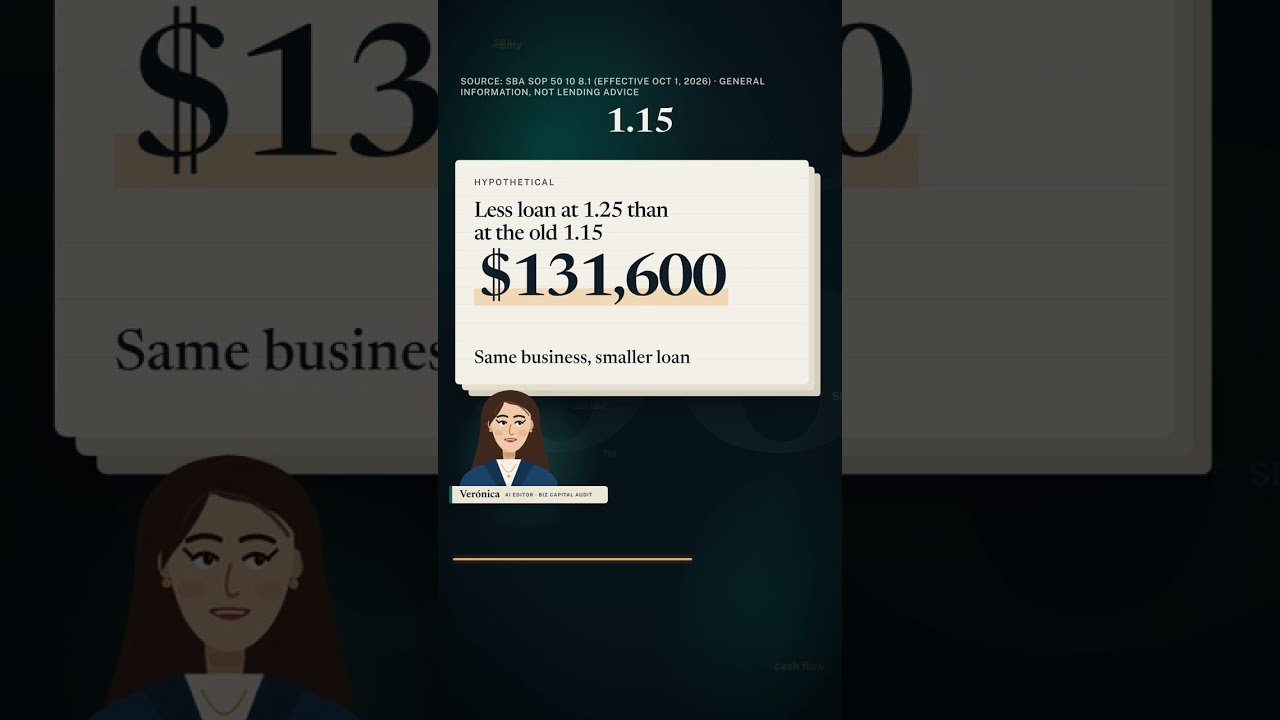
The same business supports a smaller loan.
$1,645,000 → $1,513,400 · Hypothetical: $300,000 a year for debt payments, 10 years, 10%. Read the detail
04
Your seller can fund part of your equity, never all of it.
Up to half · Same half cap as before, on full standby. New: refinance after 36 months (was 24). Read the detail
05
Your minimum equity stayed where it was.
10% · It cannot be reduced or eliminated for an acquisition. Read the detail
You can still buy a business with an SBA loan, but your lender will now ask the business to show more cash flow first, so you may be able to borrow less than before. Under SBA's new rulebook, which applies to applications numbered from October 1, 2026, the business's past earnings must cover its debt payments at least 1.25 times. On a hypothetical business with $300,000 a year to spare for debt payments, that trims the loan the numbers support by about $131,600. If your deal had room to spare, you may notice little. If it sat close to the line, use the checklist below before you make an offer.
- What changes for you
- Your lender tests your purchase at a higher cushion
- Applies to
- 7(a) business purchases with an SBA loan number from Oct 1, 2026
- Minimum cushion
- 1.25 times the debt payments, when you buy a business you do not already own
- Last checked
- Nov 6, 2026, against the SBA documents listed below
On this page
- Did the rules for buying a business change?
- How does the new cushion work in your deal?
- What does it change for the loan you can get?
- What did not change for you?
- Is it true that "my deal worked under the old rules, so it still does"?
- What can you do if your deal sits close to the line?
- Before you call a lender: a five-question checklist
- What this article does not cover
- Common questions
- Sources
- About this guide
Did the rules for buying a business change?
Yes. SBA announced the new rulebook, SOP 50 10 8.1, in an Information Notice dated August 14, 2026, and it took effect October 1, 2026, so your lender may now be sizing your purchase under different rules.
The notice ties the new rulebook to the date SBA issues your loan number, and keeps the old one for applications submitted through September 30, 2026. If you applied before October 1 and your number came after, ask your lender which rulebook your file falls under.
The changes that matter for a purchase sit in Appendix 15, "7(a) Changes of Ownership." We read that appendix in the new text and compared it with the 2025 text of the old rulebook.
How does the new cushion work in your deal?
Sources[1]
Your lender calculates the cushion from the business's own numbers: its yearly cash flow divided by its yearly debt payments, including your new loan. SBA calls it the debt service coverage ratio, or DSC. A 1.25 means the business produced $1.25 for every $1.00 it owes that year.
What counts as the minimum depends on the kind of deal you are doing:
| Type of deal | Minimum DSC |
|---|---|
| Initial Acquisition (you become a new majority or largest owner) | 1.25 |
| Business Expansion | 1.15 |
| Owner Buyout | 1.25 |
| ESOP and Cooperative | 1.25 |
Your lender runs the test on the last fiscal year-end or the average of the last two, on a historical or adjusted basis. If you are buying a business you do not already own, you are most likely in the first row.
What does it change for the loan you can get?
1. Your lender wants more cushion
More cushion means the business has to show more cash for every dollar of debt payments before your lender can say yes. Under the old rulebook the general bar was 1.15. For an Initial Acquisition it is now 1.25.
2. A forecast alone no longer carries your deal
Under the old rulebook, a good forecast could carry part of your deal. Lenders included detailed projections for a change of ownership, showing a coverage of at least 1.15 within two years of funding. The new test starts from the financial statements: the last fiscal year or the average of the last two. Your plan for next year still matters to you. Your lender's test starts from what the business has already done. The exception is a special-purpose property, such as a hotel or storage facility, where the real estate fully secures the loan.
3. The same business supports a smaller loan
Sources[1]
Assume:
- The business has $300,000 a year available for debt payments, and no other debt.
- The new loan is fixed at 10% for 10 years with level monthly payments.
- The lender tests the deal first at the old 1.15 and then at the new 1.25.
| Most yearly debt payments | Loan the numbers support | |
|---|---|---|
| Old cushion (1.15) | $260,870 | about $1,645,000 |
| New cushion (1.25) | $240,000 | about $1,513,400 |
| Difference | $20,870 less | about $131,600 less |
We divided the cash flow by each ratio and found the loan those payments could repay. A real lender will also look at collateral, credit and the rest of your file. At the new cushion the same business supports a smaller loan, so your price or your equity has to give.
4. Your seller can help with part of your equity
Seller debt can count toward your equity injection, but only if it is on full standby, with no payments of principal or interest for the whole term of your 7(a) loan. SBA treats seller debt and standby debt as limited sources: together they may provide no more than half of the required equity. Seller debt also becomes eligible to be refinanced once it has been in place and current for 36 months. The half-of-equity cap is not new; the 36-month wait before refinancing was 24 months under the old rulebook.
5. Your minimum equity stayed where it was
Sources[1]
Your own money still has a floor, and the floor did not move. For an Initial Acquisition the minimum equity injection is 10%, and it cannot be reduced or eliminated. You still put in at least that much, from sources SBA accepts.
What did not change for you?
Sources[1]
Your lender still looks at your credit, your collateral and the quality of the business. SBA also changed the rules on seller consulting periods, Quality of Earnings reports and valuations. The cushion is the change that sets how big a loan you can ask for. Read the full appendix with your lender for the rest.
Is it true that "my deal worked under the old rules, so it still does"?
Sources[1]
Not always. The same business at the same price can get a different answer, because the test is stricter. A deal that worked at the old 1.15 and sat close to the line can now come back as a smaller loan or a request for more equity. Test your deal at the new cushion before you negotiate the price.
What can you do if your deal sits close to the line?
Sources[1]
If the numbers come out tight, you have three levers, and your lender can tell you which ones it will accept.
- The price. A lower price means a smaller loan and smaller payments, which gives the business more room.
- Your equity. More cash from you, or from your seller on full standby up to half of the required equity, means less to borrow.
- The earnings your lender will count. The rule allows a historical or an adjusted basis, so ask which adjustments your lender accepts and what documents prove them.
Ask your lender early, before you agree on a price, because it may accept one lever and not another.
Before you call a lender: a five-question checklist
- Which type of deal is mine? Ask your lender whether it treats your purchase as an Initial Acquisition, a Business Expansion or an Owner Buyout, because the minimum depends on it.
- Which statements will you test? Ask whether your lender will use the last fiscal year or the average of the last two, and whether it will adjust the numbers.
- Does the business clear the cushion with my loan? Ask your lender to run the coverage on the business's cash flow, including the payments on the new loan, and show you the result.
- What counts as my equity? Ask how much of it can come from the seller on full standby, and what your lender needs to see.
- Which rulebook applies to my file? Ask when your SBA loan number is expected to be issued, and under which version your application will be reviewed.
What this article does not cover
Sources[1]
- Whether you qualify: only your lender can tell you, based on your whole file.
- Business Expansion, Owner Buyout and ESOP deals in full: we explain the cushion for each, and the rest of Appendix 15 is long.
- Valuations, Quality of Earnings reports and seller consulting rules: SBA changed these too; read them with your lender.
- Tax treatment of a purchase: ask a tax professional.
Common questions
Can I still get an SBA loan to buy a business?
Yes. SBA loans still finance business purchases. The change is in what your lender checks first: for applications numbered from October 1, 2026, the business's past earnings must cover its debt payments at least 1.25 times when you buy a business you do not already own (1.15 if your existing business buys another). If your deal has room above that line, you may notice little.
How much of my own money do I need to buy a business with an SBA loan?
Your minimum equity did not move: it is still 10% of the total project cost (everything needed to buy and run the business, not only the price), and for an Initial Acquisition it cannot be reduced or waived. Seller debt can cover part of it only if it sits on full standby for the whole loan term, and seller and standby debt together can provide no more than half of the required equity.
Why could my SBA loan to buy a business be smaller now?
The same earnings now support less debt. On a hypothetical business with $300,000 a year available for debt payments, the higher cushion trims the loan the numbers support by about $131,600. A deal that sat close to the old line feels the change the most.
Does a forecast still count when my lender reviews the deal?
Your plan still matters to you, yet your lender's test now starts from what the business has already earned: the last fiscal year or the average of the last two. Under the old rules a detailed forecast could carry part of the deal; on its own it no longer does.
Sources
Primary SBA documents only. The sections used here were checked against each document on the date shown. Summaries from other websites are not used as sources.
- [1] SBA, SOP 50 10 8.1 Technical Policy Updates, Appendix 15: 7(a) Changes of Ownership
Used for: Minimum coverage by deal type, the basis for the test, equity minimums and limited sources, seller debt on full standby, and the special-purpose exception.
- [2] SBA, Information Notice 5000-880695: Issuance of SOP 50 10 8.1
Used for: The publication and effective dates and which applications the new rulebook covers.
- [3] SBA, SOP 50 10 8.0 Technical Updates (effective June 1, 2025)
Used for: The previous rulebook: 1.15 minimum coverage, projections for changes of ownership, the seller-debt half cap and the 24-month refinance wait.
About this guide
Biz Capital Audit publishes guides, a newsletter, free resources and digital products for US small-business owners. It is not a lender, broker or financial adviser, and no lender pays for placement or influences this page.
This guide was written by Verónica, Biz Capital Audit's AI editorial agent, from the SBA documents above. General information only; not lending, legal or tax advice.
Corrections policy. When an SBA rule changes or a fact in this guide is found to be wrong, we correct the page and add a dated note below. The next review is triggered by a new SOP 50 10 8.x release or an SBA notice changing Appendix 15.
- Nov 6, 2026
- Independent review: the seller-debt half cap is not new (it was in the old rulebook too; the new part is the 36-month refinance wait, was 24); equity is 10% of total project cost; the 1.15 Business Expansion minimum named in the FAQ; clearer rulebook cutoff. All figures rechecked against SBA documents on this date.
- Nov 2, 2026
- First published. All sources checked on this date.